
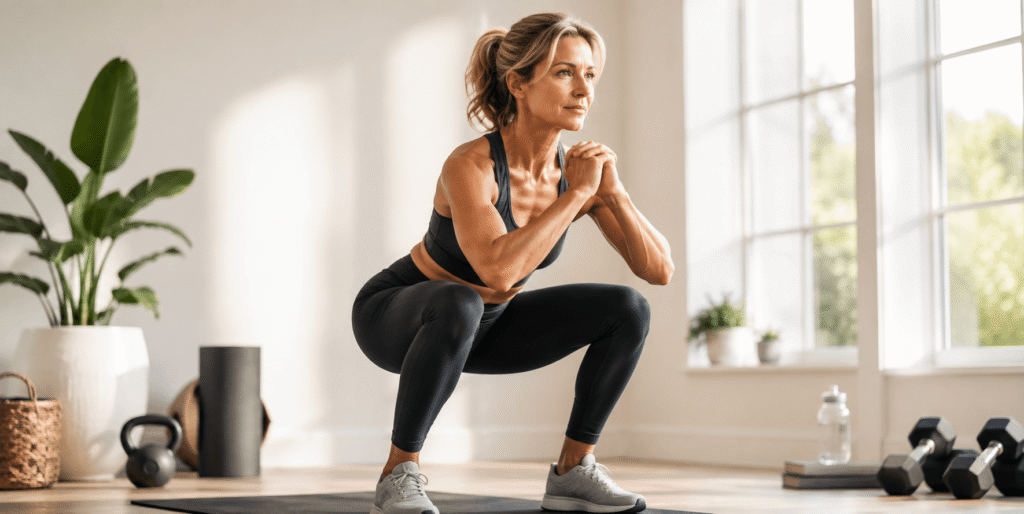
There is a growing body of research pointing to something surprisingly simple about longevity: leg strength is one of the strongest predictors of how long and how well a person lives, with stronger lower-body muscles linked to lower mortality and better healthspan—not just lifespan or life expectancy on paper, but more years of independent, healthier life. Not just for climbing stairs or keeping up with grandchildren, but as one of the clearest signals researchers have for how well a person is aging and how age related diseases, falls, fractures, osteoporosis, obesity, diabetes, and loss of function may affect the years ahead.
For women in midlife, this is both a wake-up call and an opportunity. This is for midlife women who want to build strength with a clear longevity focus, before the muscle loss, body composition shifts, and increased risk that often accelerate in the years leading to old age. Ahead, we look at what leg strength can tell us about human longevity, why midlife muscle-building matters, which exercise and physical activity strategies best support maintenance and growth, how peptides and other therapies may support recovery and treatment, and what a practical weekly plan can look like if your goal is a longer, stronger
The evidence: leg strength tracks with human longevity
Large studies that follow thousands of people over many years keep arriving at the same conclusion. In a 2026 cohort of more than 13,000 adults aged 65 and older, those with the best lower-body strength and balance had dramatically lower death rates over seven years. People in the top fifth for a simple chair-stand test had roughly 45% lower mortality than those in the bottom fifth, and the pattern held even after accounting for existing illnesses and reported activity levels.
This is not just an “older adult” story, and it is not just about men. A 2026 study of nearly 5,500 women found that two easy strength measures—grip strength and how fast a woman could rise from a chair five times—strongly predicted survival. Women in the strongest group had about a third lower risk of dying over the follow-up period, shifting the focus from simply adding years to preserving healthspan—the years lived in good health and functional independence—even among women who were not meeting recommended aerobic activity levels. A large Norwegian study of older women found much the same: poor performance on a chair-rise test predicted higher death rates from all causes and from heart disease, independent of how much the women exercised.
Why the legs specifically? Lower-body strength underpins balance, walking, and the ability to catch yourself when you stumble—which means it protects against falls and fractures, major drivers of disability and death as women age. Muscle strength also appears to be a broad marker of overall physiological reserve, reflecting the health of the whole body rather than any single organ, and clarifying that longevity is broader than average life expectancy because it also speaks to how long a person lives with good function.
Why midlife is the moment to act
Muscle strength declines steadily through adulthood, and the drop in estrogen across the menopause transition affects muscle mass, body composition, and stability. That makes the years around menopause a pivotal window, as changes can occur quickly and raise the increased risk of osteoporosis in old age. The encouraging news is that this window is very much open: a 2025 trial found that peri- and postmenopausal women gained strength and balance from resistance training just as well as young premenopausal women, even without hormone therapy. In anti-aging medicine, resistance training is often part of a broader treatment plan, and some patients may also discuss other therapies with clinicians to support bone, muscle, and connective tissues while helping maintain healthy body weight and potentially decrease age-related decline without changing underlying cancer screening needs.
How to build leg strength faster with resistance training
The research points to a few principles that help midlife women see gains sooner rather than later, because age-related changes continue through adulthood and often speed up in midlife as estrogen levels decrease, which affects muscle mass, balance, and body composition. The menopause transition also raises osteoporosis risk as bone tissue changes, and these shifts are shaped by genetic, environmental, and lifestyle factors.
- Train legs at least twice a week. This kind of strength training supports lower-body function, and national guidelines recommend muscle-strengthening activity on two or more days per week.
- Prioritize a handful of high-value movements. Studies of resistance programs for postmenopausal women lean heavily on leg press, leg extension, and squatting or chair-stand-style movements—exercise that loads the big muscles of the thighs and hips. Adding sit-to-stand repetitions from a chair trains the exact movement that predicts longevity in the research.
- Lift with enough resistance to be challenging. The most effective programs use loads around 80% of maximum effort, typically in the range of 8 to 10 repetitions per set for three sets. This kind of work can help maximize strength while supporting healthier body weight over time.
- Start where you are, then progress. For someone new to lifting, a sensible entry point is 8 to 10 repetitions of 8 to 10 exercises for the major muscle groups, beginning at about 40% of maximum and building up. Brief professional instruction at the start pays off, after which much can be done at home with minimal equipment. For example, pairing progressive loading with a healthy diet can support better adaptation.
- Don’t skip balance and functional movement. Combining strength work with balance and “real-life” movements—rising from the floor, carrying loads, stepping and reaching—improves strength, balance, and everyday function more than machine-based strength work alone. Regular physical activity also has positive effects on the brain, and balance and agility were among the very strongest predictors of survival in the recent research.
- Keep walking, too. Pairing resistance training with regular brisk walking rounds out the fitness picture, and the combination of strength work plus meeting aerobic activity recommendations is linked to the lowest mortality of all. A sound diet, good sleep, and stress control matter here because excess body fat, insulin resistance, obesity, and diabetes can affect healthy aging and decrease resilience; hormone therapy may also be an option for high-risk postmenopausal patients, since estrogen therapy may decrease osteoporosis risk.
Peptides and growth hormone that accelerate strength, recovery, and resilience
Midlife women who are serious about building lower-body strength don’t have to rely on training alone. Peptide therapy is a complement to a structured strength program, and two combinations in particular are especially well suited to the goals covered in this article: building muscle and protecting the joints, tendons, and connective tissue that make consistent training possible. In longevity medicine, these approaches are better viewed as supportive options within a broader treatment plan than as stand-alone fixes for human longevity.
CJC-1295 and Ipamorelin work together to stimulate the body’s natural production of growth hormone, and this combination is often used to support lean muscle growth during a resistance training program. CJC-1295 extends the duration of growth hormone release, while Ipamorelin triggers a clean, strong pulse of that release without affecting cortisol or appetite the way older-generation secretagogues do. For a midlife woman training her legs twice a week, this combination supports the muscle protein synthesis, recovery, and lean tissue growth that resistance training is designed to trigger. It also supports better sleep quality and fat metabolism, both of which compound the benefits of a strength program and make it easier to sustain training intensity from week to week. Given that estrogen decline affects muscle mass across the menopause transition, this peptide combination may be especially relevant during the exact window this article identifies as pivotal. Still, scientists continue to study how these signals influence cells, stem cells, and surrounding tissues over time, and whether the same benefits seen in athletes or select patients consistently occur in humans. That matters because obesity, diabetes, and other age related diseases can alter recovery and hormone response, and any intervention that shifts growth pathways must also weigh longer-term concerns such as cancer and heart failure risk.
BPC-157 and TB-500 are the peptide combination of choice for protecting the tendons, ligaments, and joints that carry the load of a leg-strengthening program. BPC-157 accelerates the repair of tendon, ligament, and muscle tissue and reduces the inflammation that can sideline a new training routine. TB-500 promotes flexibility, improves circulation to injured tissue, and works alongside BPC-157 to speed recovery between sessions so that training frequency—the single biggest driver of the strength gains described above—doesn’t have to be interrupted by soreness or minor injury. This combination is particularly valuable for women adding sit-to-stand, squat, and balance-based movements to their routine, since it strengthens the connective tissue that protects against the falls and fractures this article highlights as a major risk in aging women. Together, BPC-157 and TB-500 support tissue maintenance and may help lead to more consistent training, which is exactly what the research shows is required to move the longevity needle. But while peptide therapies are promising, there is little evidence to prove they outperform the fundamentals, and anti-aging supplements should be approached carefully rather than casually.
A realistic weekly template
A practical approach for a midlife woman might look like two lower-body strength sessions a week (built around squats or chair stands, leg press, hip and thigh work, and a couple of balance drills), plus most days of moderate walking. Other factors matter too, so pair that plan with a healthy diet, good sleep, and regular check-ins as part of a broader lifestyle approach. For example, steady physical activity and basic exercise habits support long-term maintenance better than short bursts of effort. Progress the weight or repetitions as movements start to feel easy. Consistency over months, not intensity in any single session, is what shifts the strength—and the longevity—needle, but any treatment plan should be individualized.
The bottom line
Leg strength is one of the most powerful, modifiable markers of healthy aging in women, and midlife is the ideal time to invest in it. A simple, twice-weekly leg-focused strength routine—challenging, progressive, and paired with walking and balance work—builds the kind of strength that the science links to a longer, more independent life. Supporting that training with targeted peptide therapy accelerates the results and protects the body along the way.
